Your best buyer just evaluated you. You weren’t invited.
No demo. No discovery call. No friendly SDR working the room. A software agent read your site, lined you up against four competitors, compressed all five into a single paragraph, and moved on. By the time a human glances at the shortlist, the cut is already made.
This isn’t a forecast. It’s a reclassification of how B2B buying works.
Gartner projects that by 2028, 90% of B2B buying will be AI-agent intermediated, more than $15 trillion in spend routed through automated exchanges. The same firm expects AI agents to outnumber human sellers ten to one by that year. Read it twice. Not assisted by agents. Intermediated by them. The first buyer in nearly every deal is about to be a bot.
I’ve spent three years arguing the danger of AI was compression, that every copilot summarizing your message flattens it into the Sea of Sameness. I was half right. Compression was never the endgame. Decision was. The machine doesn’t just shorten your story. It decides whether your story makes the list.
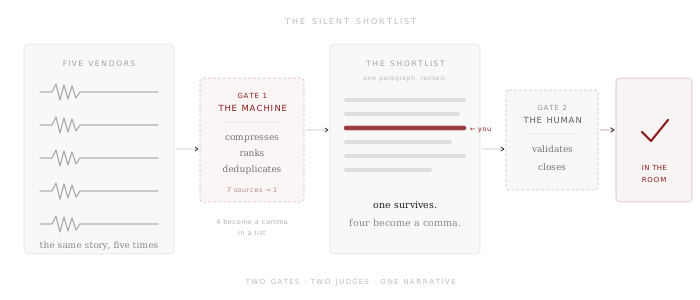
Call it the Silent Shortlist. The ranked, paragraph-long verdict an agent renders on your category before a single human in the buying group has formed an opinion. You will never see it happen. You will only see the outcome: in the room, or not in the room.
The funnel didn’t shrink. It moved.
Here’s the part most leaders miss. Buyers didn’t stop doing research, they handed it to a machine. Gartner’s latest survey of 645 B2B buyers found 45% already used generative AI in a recent purchase, mostly to size up vendors and products, while pulling from an average of seven information sources per decision. Seven sources. One agent. The agent’s job is to take those seven and return one.
That one paragraph is your new homepage hero. Not the line your designer obsessed over. The line a model wrote about you, on its own, in language you never approved. Your carefully built narrative, the deck, the demo, the talk track, was engineered for a human at the bottom of the funnel. The agent sits at the top, and it never forwards the human a vendor it couldn’t summarize, couldn’t differentiate, or couldn’t trust.
So the question stops being “is our messaging good?” and becomes something colder: what does the machine say when we’re not in the room?
Sameness used to bore people. Now it gets you cut.
When every competitor feeds the same LLMs the same prompts, you get the same output: perfectly polished, technically flawless, and completely forgettable. For a human reader, sameness was a nuisance. They’d skim, shrug, move on. Annoying, survivable.
For an agent, sameness is fatal. An agent optimizing for fit, proof, and clarity can’t choose a wallflower. If your narrative reads like the four around it, the agent doesn’t note the resemblance and feel bad about it. It deduplicates. One of you survives the paragraph. The other four become a comma in a list.
And it gets worse, because the machine is confidently wrong on a schedule. In that same Gartner survey, 51% of buyers said they’re more likely to encounter misleading information from GenAI than from a sales rep. Think about what that means when the GenAI is the buyer. A weak signal doesn’t just get ignored, it gets actively misrepresented, fluently, authoritatively, with no rep in the room to correct the record. The old game of telephone had people between you and the buyer. The new one has a machine that doesn’t just distort the message. It makes the shortlist.
This is the Signal / Whisper Ratio™ with the stakes raised. The whisper used to cost you nuance. Now it costs you the deal.
The plot twist: the human never left.
Here’s where the obvious move (write everything for the robots) walks you straight off a cliff.
Because the buyers handing research to agents are the same buyers who refuse to trust them. In Gartner’s data, 69% of B2B buyers still turn to a human rep to validate what the AI told them. By 2030, Gartner expects 75% of buyers to prefer sales experiences that prioritize human interaction over AI. The agent makes the shortlist. The human still closes the deal.
So the answer isn’t robots or humans. It’s robots then humans. You have to be distinct enough to survive the machine and human enough to win the validation that follows. Two gates. Two judges. One narrative that has to clear both.
That’s not a tooling problem. You can’t prompt your way out of it, because your competitor has the same prompt. The only input the machine can’t generate and can’t flatten is the one thing AI will never have: the genuine stories of the real people who buy, build, and sell your product. Radical authenticity isn’t a brand mood anymore. It’s the last asset an agent can’t fabricate and a human can’t forget.
What to actually do about it
Three moves. Not someday, this quarter.
Make your narrative machine-legible. Write your Brand Checksum™, the 12-25 words that have to survive every summarizer, every analyst bot, every agent compressing seven sources into one. If you can’t say which words you’d bet the quarter on, the machine will pick them for you. It will pick wrong.
Measure how you survive compression. Run your story through the gauntlet on purpose. Score the Signal / Whisper Ratio™: what makes it through the machine intact, and what turns to mush. You can’t fix a whisper you’ve never heard.
Anchor it in human truth the agent can’t invent. Capture the customer champions, the employee voices, the partner stories, the proof the model can’t hallucinate because it never happened to a model. That’s the Authenticity Engine™, and it’s the difference between surviving the shortlist and winning the room after it.
The agents are already in the field. Gartner notes that even as they outnumber sellers ten to one, fewer than 40% of sellers say the agents have made them more productive, which tells you the buy side is industrializing faster than the sell side can answer. The advantage, for once, is going to the company that moves first.
The Silent Shortlist is being built right now. By a machine. Without you in the room. The only thing you control is whether your name is still on it when the human looks.
Don’t whisper. The machine can’t hear you, and the buyer won’t wait.
Sources
- Gartner, Gartner Unveils Top Predictions for IT Organizations and Users in 2026 and Beyond (Oct 21, 2025) — 90% of B2B buying AI-agent intermediated and over $15T in spend by 2028. gartner.com
- Gartner, Gartner Predicts By 2028 AI Agents Will Outnumber Sellers by 10X — Yet Fewer Than 40% of Sellers Will Report AI Agents Improved Productivity (Nov 18, 2025). gartner.com
- Gartner, Gartner Survey Finds 69% of B2B Buyers Turn to Sales Reps to Validate AI-Generated Insights (May 20, 2026) — 645 buyers surveyed Aug–Sept 2025; 45% used GenAI; avg. 7 information sources; 51% more likely to encounter misleading info from GenAI vs. 49% from a rep. gartner.com
- Gartner, Gartner Says By 2030 that 75% of B2B Buyers Will Prefer Sales Experiences that Prioritize Human Interaction Over AI (Aug 25, 2025). gartner.com