Eight hundred percent.
That’s how far hiring for a single job title climbed between January and September of last year. Not a category. Not a function. One title: Forward Deployed Engineer. (Indeed and the Financial Times did the counting.)
Salesforce committed to hiring a thousand of them. OpenAI, Anthropic, and Databricks are each standing up dedicated FDE functions. In April, EY launched a whole practice around the role. Senior ones clear $500,000, because there are maybe a few thousand humans on the planet who can actually do the work.
Here’s what nobody issuing the press release wants to say out loud. This is a confession. The most sophisticated software companies in the world just admitted the model isn’t enough.
The playbook that broke on contact
For fifteen years the playbook was rock solid. Build the product. Ship the API key. Let the customer figure out the rest. SaaS scaled because the code behaved identically in every building it landed. It was deterministic, repeatable, and boring in the best way. Click the button, get the result. Every time.
Generative AI broke that on contact. The same prompt yields a different answer on Tuesday than it did on Monday. Enterprise data is a junk drawer. It is siloed, filthy, and half-labeled. Drop a frontier model into that mess and it doesn’t shine. It hallucinates. It leaks. It stalls.
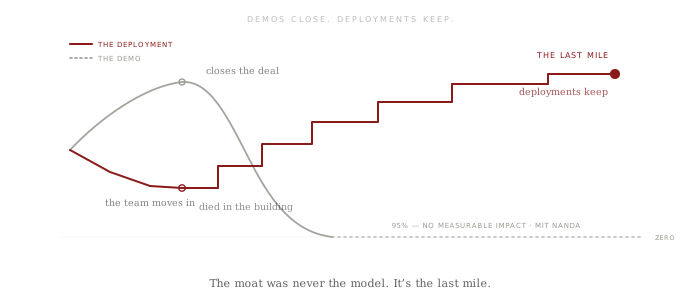
The model crushed the demo and died in the building
And the scoreboard is brutal. MIT’s NANDA initiative studied 300 enterprise AI projects and found 95% produced no measurable impact on the bottom line. Not because the models were weak. Because the deployments never happened. The model crushed the demo and died in the building.
Demos close deals. Deployments keep them.
So the labs are doing the only thing that works. They’re sending people. Not documentation. Not a support queue. Elite engineers who move into the customer’s environment, wire the thing into the real stack, and refuse to leave until it runs. You don’t send a manual into a firefight. You send the team.
Palantir ran this play for a decade
None of this is new. It’s just newly fashionable. Palantir has been running this play since the early 2010s. They called them Deltas. Until 2016, Palantir had more Deltas than it had software engineers. In other words, there were more people deploying the product than building it. The Valley laughed. Too services-heavy, too expensive, doesn’t scale, not a “real” software company.
Palantir is now worth more than most of the companies that laughed.
Here’s the part worth slowing down for, because it’s a positioning story hiding inside an org-chart story. The frontier labs are bolting the FDE model on. Acquiring deployment shops. Spinning up new orgs. Writing $500K offers. Retrofitting a services muscle onto a product company, mid-flight, because the market left them no choice.
Some companies were born embedded
Some companies never had to bolt anything on. They were born embedded.
Scale AI opened its doors in 2016 as a data-labeling shop: human-in-the-loop, hands in the data, parked right next to the customer’s mess. Pure services DNA. Today its homepage doesn’t lead with a model. It leads with the admission that most enterprise AI deployments fail, then promises to find the use case, build the system, and own the outcome. That’s not a message they reverse-engineered last quarter. That’s the company they always were.
Sierra went further and wrote it into the price tag. You don’t pay Bret Taylor’s outfit for software. You pay when the agent actually resolves the customer’s problem. No resolution, no invoice. Critics grumble that Sierra “operates like a consultancy, not software.” That’s not the bug. That’s the entire bet, and $150 million in ARR says the bet is landing.
Which brings me to CodeVine. CodeVine didn’t find the FDE model in a strategy deck. It was built the way Scale and Palantir were built, by operators sitting in the customer’s chair, solving the problem in the room, then hardening the solution into the product.
The embedding came first. The platform came second. That sequence is the whole advantage.
And it matters more than ever, because the gap CodeVine attacks is the exact gap the FDE boom is screaming about. Faros AI found that developers using AI tools complete 21% more tasks and merge 98% more pull requests. Cool, but this was all while their organizations saw no measurable performance gain. Individual velocity, zero organizational impact. Sound familiar? It’s the 95% problem, one engineering team at a time.
You don’t close that gap with a better autocomplete. You close it by being in the building. So watch what’s actually happening here.
The moat was never the model
The 800% spike isn’t a hiring trend. It’s a reclassification. The industry just moved deployment from cost center to crown jewel. From the dull part after the sale to the only part that was ever real.
The model is becoming a commodity. Every lab has one. They’re converging on the same benchmarks, the same capabilities, the same Sea of Sameness. What can’t be commoditized is the human who shows up, learns your business, and stays until the thing works.
The moat was never the model.
It’s the last mile.
Defy the algorithm.