For the last twenty years, the playbook has been simple: master the art of Search Engine Optimization, and you will win the war for discovery. We’ve built entire industries around keywords, backlinks, and the pursuit of that coveted top spot on the results page.
That era is over.
The rise of Large Language Models like ChatGPT, Gemini, and Claude represents the most significant shift in information discovery since the dawn of the internet. Your customers are no longer just searching — they are conversing with an AI that acts as a research assistant, summarizing the entire internet for them.
In this new world, your old SEO playbook isn’t just outdated. It’s irrelevant. Welcome to the era of GEO — Generative Engine Optimization.
What is GEO, and Why is it Different?
SEO is about getting a user to click on your link. It’s a game of ranking individual pages based on specific keywords.
GEO is about getting an AI to accurately summarize your company’s story. It’s a game of influencing a knowledge base built from your entire digital footprint.
Think of it this way:
An SEO query is like asking a librarian where the section on “cloud computing” is. The librarian points you to an aisle.
A GEO query is like asking the librarian to tell you the top three most secure and cost-effective cloud providers for a mid-sized tech company. The librarian gives you a synthesized answer based on every book, magazine, and journal in the library.
If the information about your company is inconsistent, contradictory, or buried, the librarian’s summary will be weak, inaccurate — or worse, it will omit you entirely.
The Ticking Clock: Why You Need a GEO Strategy Yesterday
Traditional search isn’t disappearing overnight, but the momentum is undeniable. Gartner predicts that by 2026, over 80% of enterprises will have used Generative AI. As this technology becomes more integrated into daily workflows, LLM-based research will become the default for complex queries.
Companies that fail to adapt will face a new kind of invisibility. It won’t matter if you rank #1 for a keyword if the AI’s summary of the topic doesn’t mention you. You will be digitally erased from the consideration set.
Your 4-Step GEO Action Plan
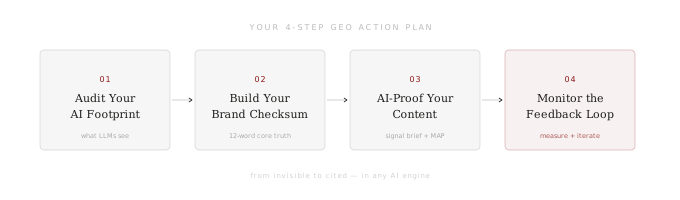
Preparing for this shift isn’t about gaming an algorithm — it’s about a disciplined, strategic approach to managing your brand’s narrative across the web.
Step 1: Conduct a Narrative Audit
Go to three different LLMs and ask them to describe your company, your key differentiators, and your top competitors. Is the summary accurate? Is it compelling? Does it reflect your current positioning? This is your baseline.
Step 2: Centralize Your Source of Truth
Create a master document that clearly defines your company’s mission, vision, “About Us” story, key value propositions, and official product descriptions. This narrative must be consistent and approved at the highest level.
Step 3: Enforce Narrative Consistency Across All Channels
An LLM learns from everything. Systematically review and update your owned properties (website, blog, social media), earned properties (press releases, media mentions), shared properties (LinkedIn, Crunchbase, Glassdoor), and ecosystem properties (how partners describe you).
Step 4: Build a Chorus of Authentic Proof
Actively encourage and amplify customer reviews on G2 and Capterra, get your executives to share insights on LinkedIn that align with your core story, and create case studies that bring your narrative to life. Each piece of authentic content is another data point that trains the AI on your credibility and market position.
The Bottom Line
The shift from SEO to GEO is not a minor technical change — it is a fundamental reordering of how brands are discovered and evaluated. The companies that will win in this new era are not the ones with the most backlinks, but the ones with the most consistent, compelling, and authentic story.