Let’s get something straight: the SaaS pricing model you’ve been paying into for the last decade was never really about software. It was about people.
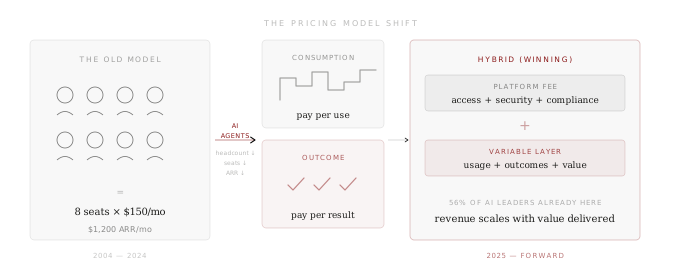
More employees meant more seats. More seats meant more ARR. It was beautifully linear, elegantly predictable, and utterly dependent on one assumption — that humans would always be the primary unit of work.
That assumption just died.
The SaaSpocalypse Was Not an Accident
In February 2026, the iShares Expanded Tech-Software ETF dropped over 21% in weeks. Atlassian fell 36% in a single month. Workday — a company that sells workforce management software — cut 8.5% of its own workforce because of AI. Monday.com’s CEO publicly replaced 100 SDRs with AI agents. The financial press called it the SaaSpocalypse, and the thesis was brutal in its simplicity: AI agents don’t pay per seat. And neither do the humans whose jobs they’re replacing.
This wasn’t a correction. It was a reclassification. Wall Street looked at the velocity of agentic AI and concluded that hundreds of software companies were structurally overvalued — not because their products were bad, but because their pricing model was built for a world that no longer exists.
Apollo Global Management slashed their software exposure in private credit funds from 20% to 10%. When sophisticated institutional capital makes that kind of move, you don’t dismiss it as market noise. You pay attention.
The Original Sin of Per-Seat Pricing
To understand why this is happening, you have to understand what per-seat pricing was actually measuring.
It was measuring adoption. Logins. Humans touching the product. A CRM helped a sales rep. A design tool helped a designer. A support platform helped an agent. You could count your customers by counting their logins, and growth looked like this: more employees → more seats → more ARR.
That model worked brilliantly — right up until AI made your employees 10 times more productive, which meant you needed 10 times fewer of them. And when a company cuts headcount, the first call they make is to their SaaS vendors.
As one analyst put it bluntly: “Seat pricing is a tax on humans. And in the next decade, humans stop being the primary unit of work.”
What Replaces It? Three Models Fighting for Dominance
The industry isn’t collapsing — it’s repricing. And three new models are competing to become the standard:
1. Consumption-Based / Usage Pricing
Pay for what you use — API calls, tokens, queries, documents processed. This is how AWS built a trillion-dollar business, and it’s where AI-native companies are starting. The problem: it introduces unpredictability that CFOs hate and boards can’t model.
2. Outcome-Based Pricing
This is the audacious one. Instead of charging for access, charge for results. Salesforce and ServiceNow have already begun charging for tasks completed rather than seats occupied. Klarna’s AI assistant handled two-thirds of customer service chats — if you’re the vendor, why charge for 30 human seats when you could charge a percentage of the value you’re delivering?
The problem: revenue unpredictability. Your CFO will hate it. Your board will demand you explain it to analysts every quarter. The whole point of SaaS was recurring, predictable revenue.
3. Hybrid Pricing
The pragmatic middle ground — and where most companies are landing. A base platform fee for access, security, and compliance, plus variable fees tied to usage or outcomes. Roughly 56% of AI leaders now use hybrid models, according to recent research. It’s not elegant, but it’s survivable.
The 2026 Renewal Cliff You Need to Prepare For
Here’s what keeps me up at night for the companies I advise: the renewal cliff.
In 2025, most enterprises were in the adoption phase of AI — funding experiments out of innovation budgets, running pilots, buying curiosity. CFOs weren’t asking hard questions yet. They will be in 2026. Those pilots are converting to production contracts, and the ROI reckoning is coming. If your SaaS vendor can’t show hard business outcomes at renewal time, the conversation is going to be very uncomfortable.
Bain & Company research found that among SaaS vendors introducing generative AI capabilities, roughly 35% simply increased per-seat pricing by bundling AI features in. That strategy will not survive the renewal cycle. Customers who are more productive with fewer people will not pay more for additional seats they don’t need.
What This Means If You’re a B2B Tech CEO or CMO
If you sell software, this is not a pricing problem. It’s an existential positioning problem.
The companies that will survive this transition are the ones that can answer one question: What specific, measurable outcome do you deliver — and can you prove it?
“We make your team more productive” is a whisper in this environment. It’s the kind of generic claim that AI summarizes away and buyers dismiss in seconds. You need a Signal that survives the scrutiny of a CFO who just watched your competitor promise the same thing and a board that’s seen a 21% software index drawdown.
This is exactly the work we do at RedLine Advisors. Not because we predicted the SaaSpocalypse — though frankly, it was inevitable — but because the companies that will command premium pricing in the AI era are the ones with narratives that are outcome-specific, proof-backed, and impossible to compress into vendor-generic noise.
Stop selling seats. Start selling outcomes. And make sure your story survives the compression.
The era of the gym membership for software is officially over.