In the first post, I talked about what happens to your messaging when it passes through machines. Features get bucketed. ROI gets rounded. Claims fall out entirely. And sometimes, the story that reaches your buyer is barely yours.
Think of this as your Signal-to-Whisper Ratio — a simple way to measure what survives compression. But to measure what’s missing, you have to know what you intended to say in the first place.
That’s where the Brand Checksum comes in.
The Simplest, Hardest Question
If a copilot summarized your company in 30 words, which 12 would you bet the quarter on?
Not the clever line in your homepage hero. Not the 3x3 messaging matrix in your deck. The one line that needs to survive every summarizer, every analyst bot, every internal email recap from your buyer to their exec.
Twelve words. No fluff. No backstory. Just the essence.
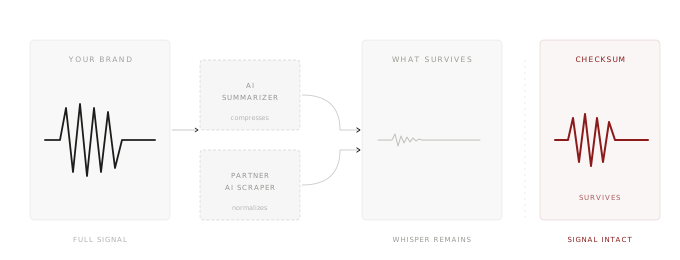
Because in a machine-mediated buying process, your message doesn’t get full airtime. It gets compressed, summarized, and flattened. If you don’t define your checksum, the model will define it for you — and you might not like what it chooses.
What a Checksum Actually Is
In data systems, a checksum is a way to detect changes or corruption. Think of it this way: imagine you’re sending a package with a small, unique sticker on it. When the package arrives, the recipient checks if the sticker is still intact. If it’s damaged or missing, they know something happened during delivery — even if the contents seem okay.
A Brand Checksum works the same way. It’s not your full story. It’s not your elevator pitch. It’s your integrity marker — the line that lets you recognize whether the version of your message that made it through still resembles the one you sent.
You don’t have to publish it word-for-word. You just have to know it, and place it where machines will find it.
Compression Beats Nuance
The mistake most brands make is thinking that good messaging will survive on merit. That if it’s clear, differentiated, and true, it will carry through.
But machines don’t optimize for merit. They optimize for compression. They’re trained to summarize quickly, normalize aggressively, and collapse anything unique into something statistically average.
That means the version of your story that gets passed along isn’t necessarily the one that’s clearest — it’s the one that’s easiest to group with others. If you don’t anchor your message with something stable and compact, you will lose fidelity.
How to Craft a Good Brand Checksum
Here’s what works in early experiments:
- Start with your outcome, not your product. What happens when someone chooses you?
- Name the buyer, explicitly or implicitly. Not just “companies” — the decision-maker, the role, the pain.
- Include your constraint. What do you deliver that others can’t? What makes your approach viable, provable, or faster?
A strong checksum isn’t flowery. It’s recognizable. Durable. Repeatable. Something that can appear in a product brief, a conference slide, a schema.org description — and still sound like you.
Twelve words is just a constraint, not a law, but try to make it as short as possible. It forces you to collapse everything that matters into a sentence that survives.
Where to Put It
If the checksum is the line you want to survive, plant it in the places machines look first:
- H1s — the first line of your most trafficked pages
- Meta descriptions — especially on product and solution pages
- Alt text and image captions — machines index these, even if humans skim
- Schema.org and OpenGraph tags — structured data that feeds search, AI snippets, and social embeds
- First sentences in PDFs and decks — summarizers often prioritize early text blocks
You’re not writing for SEO. You’re writing for GEO — generative engine optimization. Your checksum is the anchor that ensures your brand is still recognizable when the model does its sweep.
Try It Yourself
Write a 12-word checksum. No jargon. Just the outcome, the buyer, the constraint. Then search your site and materials — is that line actually present in the first 250 words?
Run a few prompts through any AI model:
- “Summarize what this company does and who it’s for.”
- “As a CFO, what’s their value?”
- “What stands out about this vendor?”
Compare the output to your checksum. How close is it?
You’ll know right away whether your message has any chance of surviving the machine layer.